

TF vs DA vs DR: What Is the Difference?
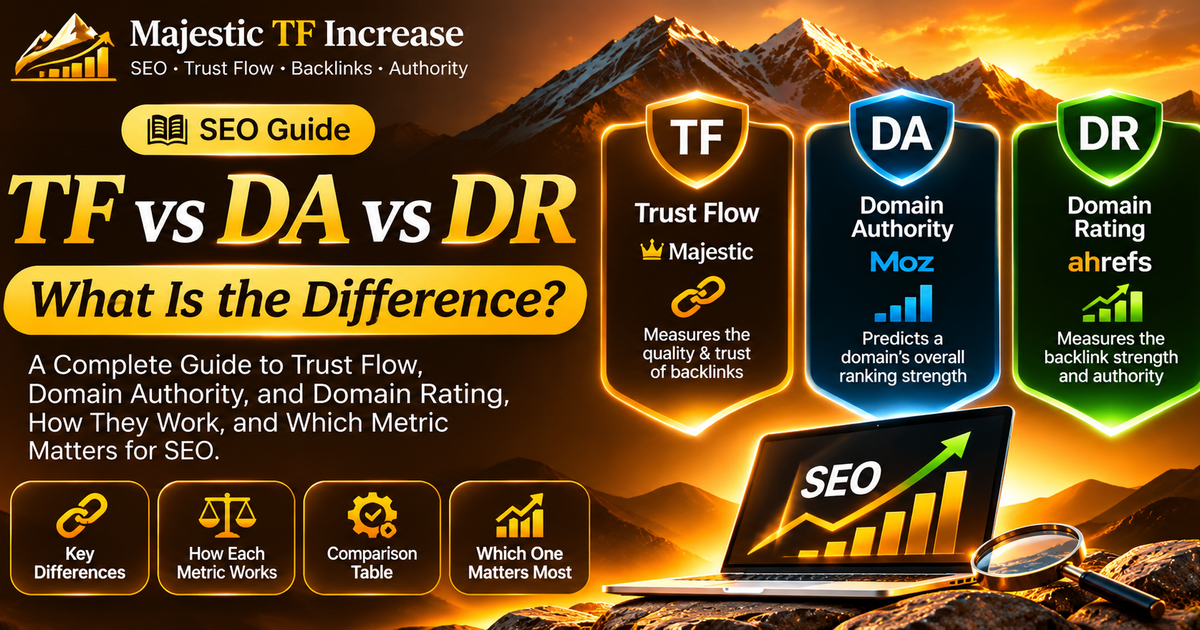
When analyzing a website for SEO, you’ll often come across three popular metrics: Trust Flow (TF), Domain Authority (DA), and Domain Rating (DR). These scores are commonly used to evaluate websites, compare competitors, analyze backlink profiles, and identify potential link-building opportunities.
Although all three metrics are related to website authority, they don’t measure exactly the same thing. Each tool uses its own data, calculations, and methodology to evaluate different aspects of a website’s backlink profile.
So, what’s the difference between TF, DA, and DR? Which metric should you focus on when evaluating a website? And is a website with DR 70 necessarily better than one with TF 40?
Let’s break it all down.
What Is Trust Flow (TF)?
Trust Flow (TF) is a metric developed by Majestic that evaluates the quality of backlinks pointing to a website. It focuses on how closely a website’s backlink profile is connected to trusted websites within Majestic’s link graph.
Trust Flow is especially useful when analyzing backlink quality and identifying whether a website has links from credible, relevant sources.
A website may have thousands of backlinks, but if many of those links come from poor-quality or unrelated websites, its backlink profile may not be as strong as the numbers suggest.
What Trust Flow Can Help You Evaluate
- Quality of a website’s backlink profile
- Trust signals associated with referring websites
- Backlink quality versus link quantity
- Potential link-building opportunities
- Website authority and link profile comparisons
Trust Flow is often used alongside Citation Flow (CF), another Majestic metric that measures link influence based largely on the quantity of links.
Example: A website with TF 35 and CF 40 may have a reasonably balanced link profile, while a site with TF 8 and CF 65 may deserve a closer backlink review. These numbers alone don’t prove that either website is good or bad, but they can help identify areas for further investigation.
What Is Domain Authority (DA)?
Domain Authority (DA) is a website authority metric developed by Moz. It uses a predictive model to estimate how likely a website is to rank in search engine results compared with other websites.
DA is scored on a scale of 1 to 100. A higher score generally indicates stronger ranking potential according to Moz’s model.
Domain Authority is not a Google ranking factor. Google doesn’t use Moz DA as an official ranking signal.
What Domain Authority Is Used For
- Comparing websites within the same niche
- Evaluating potential backlink sources
- Monitoring changes in a website’s SEO profile
- Analyzing competitor websites
- Estimating comparative ranking potential
DA is best used as a comparative metric rather than a guarantee of search performance. A website with DA 60 isn’t automatically going to rank above a website with DA 30 for every keyword.
Content quality, search intent, relevance, competition, technical SEO, and many other factors influence rankings.
What Is Domain Rating (DR)?
Domain Rating (DR) is a metric developed by Ahrefs to measure the relative strength of a website’s backlink profile.
DR primarily evaluates the strength of a website’s external backlink profile using Ahrefs’ own database and methodology. It uses a logarithmic scale from 0 to 100.
A higher DR generally indicates a stronger backlink profile within Ahrefs’ system.
What DR Can Help You Analyze
- Overall backlink profile strength
- Referring domains
- Link-building progress
- Competitor backlink profiles
- Relative link authority
DR is useful when comparing websites and reviewing link-building opportunities. However, a high DR score alone doesn’t mean a website has quality content, strong organic traffic, or good rankings.
Always review the actual website and its referring domains instead of relying exclusively on DR.
TF vs DA vs DR: Key Differences
Although these metrics are often discussed together, they have different purposes.
Trust Flow (TF)
- Tool: Majestic
- Main focus: Backlink trust and quality signals
- Scale: 0–100
- Useful for: Evaluating the trust-related characteristics of backlinks
Domain Authority (DA)
- Tool: Moz
- Main focus: Predictive comparative ranking potential
- Scale: 1–100
- Useful for: Comparing websites and estimating relative ranking strength
Domain Rating (DR)
- Tool: Ahrefs
- Main focus: Relative strength of the backlink profile
- Scale: 0–100
- Useful for: Backlink analysis, competitor research, and link profile comparisons
These scores are calculated independently. They aren’t interchangeable, and you shouldn’t expect a website to have the same TF, DA, and DR values.
TF vs DA vs DR Comparison Table
| Metric | Tool | Primary Focus | Scale |
|---|---|---|---|
| TF | Majestic | Trust and backlink quality signals | 0–100 |
| DA | Moz | Comparative ranking potential | 1–100 |
| DR | Ahrefs | Backlink profile strength | 0–100 |
Each metric provides a different perspective on your website. Using them together can help you make more informed SEO decisions.
Which Metric Is More Important?
There isn’t one metric that’s always more important than the others.
Your choice depends on what you’re trying to evaluate.
If You Want to Analyze Backlink Trust
Trust Flow can help you investigate the trust-related quality of a website’s backlinks and the relationship between its link sources.
If You Want to Compare Ranking Potential
Domain Authority can be useful when comparing websites in the same industry or analyzing potential competition.
If You Want to Analyze Backlink Strength
Domain Rating can help you compare backlink profiles and examine the relative strength of referring domains.
For a more complete SEO analysis, use these metrics alongside organic traffic, keyword rankings, referring domains, website relevance, and content quality.
Is High TF, DA, or DR Always Good?
Not necessarily.
A website can have high authority metrics but still have:
- Little or no organic traffic
- Irrelevant website content
- Poor-quality pages
- Spammy outbound links
- An unnatural backlink profile
- Weak topical relevance
- No real audience
Before choosing a website for a guest post, backlink, partnership, or SEO campaign, review the website manually.
Check its content, traffic trends, indexed pages, referring domains, outbound links, niche relevance, and overall quality.
A metric is a starting point—not the final decision.
How to Improve TF, DA, and DR Naturally
While each tool uses a different methodology, many healthy SEO practices can support the development of a stronger backlink profile.
1. Earn Relevant Backlinks
Focus on links from websites that are relevant to your industry and audience.
2. Publish Helpful Content
Create guides, tutorials, original research, resources, and content that people genuinely want to reference.
3. Build Genuine Relationships
Connect with publishers, bloggers, businesses, and industry professionals to develop natural collaboration opportunities.
4. Review Your Backlink Profile
Monitor new links, lost links, referring domains, anchor text, and potentially harmful backlink patterns.
5. Improve Website Quality
Maintain a technically healthy website, improve page experience, organize content, and make your site useful for visitors.
6. Avoid Manipulative Link Building
Don’t rely on automated spam, mass-produced links, or schemes designed solely to manipulate SEO metrics. These methods can create unnecessary risk and may not provide sustainable value.
Can TF, DA, and DR Increase at the Same Time?
Yes, all three metrics may increase as a website develops a stronger backlink profile, but their scores don’t necessarily move together.
For example, your website might gain DR after acquiring new referring domains, while Trust Flow remains unchanged until Majestic detects or evaluates changes within its own data. DA may also remain stable because Moz uses its own calculations and index.
Different tools update their databases and scores at different times.
This is normal. A change in one metric doesn’t necessarily mean another tool is reporting incorrect data.
Final Verdict: TF vs DA vs DR
Trust Flow, Domain Authority, and Domain Rating are all useful SEO metrics, but each measures a different aspect of website authority and backlink strength.
- TF helps you examine trust-related backlink quality.
- DA helps you compare estimated ranking potential.
- DR helps you evaluate relative backlink profile strength.
Rather than focusing on a single score, use all three as part of a broader SEO analysis.
A website’s real value comes from its relevance, useful content, backlink quality, organic visibility, and overall user experience—not just a number displayed in an SEO tool.
If you’re evaluating websites for SEO, backlink opportunities, or competitor analysis, understanding the difference between TF, DA, and DR can help you make smarter decisions and avoid judging a website by metrics alone.